
Stair parts · 8 min read
Landing Tread: What Is a Landing Tread?
Learn what a landing tread is, how it differs from a stair tread, where landing treads are used, and when you need a landing panel instead.
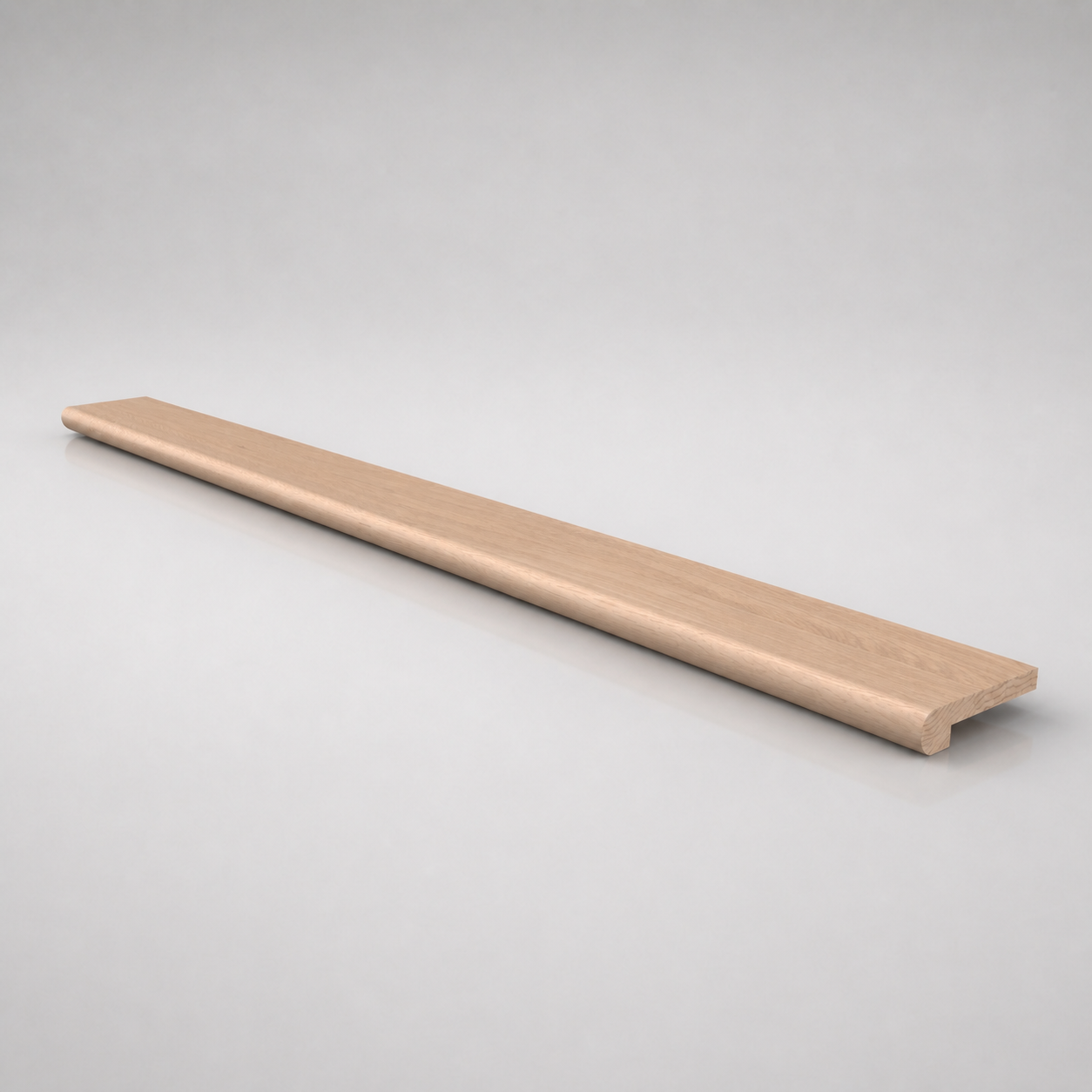
A landing tread is the finishing board that runs along the edge of a floor opening where a staircase meets the upper level. If you're mapping out the parts of a staircase, the landing tread is often the last piece installed and the one most often overlooked in planning. It's not a stair tread. It's not standard flooring. It's the transition piece that ties the stair to the upper floor, and getting it right matters both visually and structurally.
What Is a Landing Tread?
A landing tread is the board that finishes the exposed edge of the floor at the top of a staircase, where the stair meets the landing or upper floor. It has a bullnose nosing profile on one long edge, which faces down toward the stairs. That rounded or profiled edge gives the transition a finished look and protects the floor edge from foot traffic wear.
Landing treads are wider than standard stair treads. They're meant to match the thickness of the flooring they adjoin, not the thickness of the treads below them. They typically run 36" to 48" wide to match the stair opening and vary in depth based on how far the floor edge needs to be finished.
Landing Tread vs. Stair Tread
A landing tread and a stair tread look similar on the shelf. In place, they serve very different purposes.
Feature | Stair Tread | Landing Tread |
|---|---|---|
Location | Each step going up or down | Top of stair, floor edge |
Orientation in use | Angled (on the stringer) | Flat (on subfloor) |
Nosing direction | Front edge only | One long edge only |
Standard depth | 10"–11.5" | Varies: 7"–12" typical |
Thickness | 1"–1.5" | Matches flooring thickness |
Foot traffic pattern | Heavy, repeated each step | Moderate, near stair opening |
The key difference is how they're walked on. A stair tread is installed on an incline and receives a step up or down. A landing tread is flat and gets walked across laterally. The bullnose profile on a landing tread faces the stair opening, not the direction of travel.
Where Landing Treads Are Used
Landing treads show up in three places:
Top of the staircase, upper floor. The most common location. The landing tread sits at the edge of the upper floor where the top step meets the landing. It gives the opening a finished front edge that matches the hardwood flooring behind it.
Intermediate landings between flights. A landing is what ends one flight of stairs and begins the next, and a landing tread finishes each transition edge. One at the top of the lower flight, one at the bottom edge of the upper flight.
Bottom of the stair where it meets finished flooring. Less common, but sometimes used when the bottom step meets a hardwood or engineered floor and a transition piece is needed to cover the gap between the stringer base and the floor surface.
For more on how stair treads and landing treads work together, see starting steps and landing treads.
Landing Panels
A landing panel covers the full surface of an intermediate landing, not just the edge. This is the right solution when the landing floor is exposed subfloor or a different material that needs to be finished to match the stair treads.
Landing panels are large pieces of the same wood species as the treads. They're glued and fastened flat to the subfloor and finished to match. Think of it as a large stair tread that covers the entire landing platform.
When do you need a landing panel vs. a landing tread?
If the landing has existing finished flooring (hardwood, LVP, tile) that runs right up to the edge, you probably only need a landing tread at the opening edge.
If the landing has bare subfloor or a material mismatch, a landing panel brings the whole surface up to match the treads.
If the landing is small (a 90-degree turn landing, for example), a landing panel makes more visual sense than trying to run standard flooring and add an edge piece.
Landing panels can be ordered with one bullnose edge (for a single open edge), two bullnose edges (for a corner landing with two exposed edges), or square on all sides when surrounded by other flooring or walls.
Transitioning to Carpet or Flooring
The landing tread also functions as a transition piece between the stair and whatever floor covering runs across the landing or upper floor.
Transitioning to hardwood or LVP: The landing tread's bullnose edge butts up to the finished flooring. No additional transition strip is needed. The landing tread becomes the termination point of the floor on that edge.
Transitioning to carpet: The bullnose edge of the landing tread sits at the stair opening, and carpet is tucked or tacked behind it. A gripper strip holds the carpet edge near the landing tread. This is cleaner than using a T-molding and more durable at a high-traffic edge.
Landing tread vs. T-molding: A T-molding is a thin, flat strip used to transition between two floor surfaces at the same height. It's not designed for stair openings. A landing tread is purpose-built for the stair edge: it's thicker, it has a bullnose profile, and it handles the transition between a flat floor and an open stair better than a T-molding ever will.
Shop landing treads and panels
Order the landing tread in the same species and finish as your stair treads so the transition reads as one staircase.
Landing treads · 8090 landing tread · Landing platforms · Knee wall cap
FAQ
What is a landing tread? A landing tread is the finishing board that runs along the edge of the upper floor or landing where a staircase meets the floor. It has a bullnose profile on the edge that faces the stair opening. Its job is to give the floor edge a finished, durable face that matches the stair treads below.
How is a landing tread different from a stair tread? A stair tread is installed on the incline of the staircase, one per step, and takes direct vertical foot traffic with each step. A landing tread is installed flat on the upper floor or landing, at the edge of the stair opening. It's typically wider, matched to flooring thickness rather than stair tread thickness, and receives lateral foot traffic rather than step-on-step impact.
Do I need a landing tread at the top of my stairs? Yes, in almost all cases. The edge of the upper floor at the stair opening is exposed on its front face. Without a landing tread, that edge is raw subfloor or cut flooring. A landing tread covers it, matches the tread species below, and protects the edge from wear.
What is a landing panel? A landing panel is a large board (or assembly of boards) that covers the entire surface of a landing, not just the edge. It's used when the landing floor needs to be finished in the same wood species as the stair treads. A landing panel can have one or two bullnose edges depending on how many sides of the landing are exposed.
Keep reading
All resources GuideStair partsRise and Run: What Are They and How Do You Calculate Them?Rise and run are the two core dimensions of every stair step. Learn the standard sizes, how to calculate them, and what the building code requires.8 min read
 GuideStair partsBaluster: What Is a Baluster?A baluster is the vertical post that fills the open space of a stair railing. Learn how they differ from spindles and pickets, sizing, spacing, and more.9 min read
 GuideStair partsFlight of Stairs: What Is a Flight?A flight of stairs is an uninterrupted run of steps between two levels. Learn how many stairs make a flight, the etymology, and how flights relate to landings.8 min read