
Stair parts · 11 min read
Stair Tread: What Is a Tread?
Learn what a stair tread is, how it differs from a riser and nosing, standard sizes, material options, and how treads attach to the stringer.
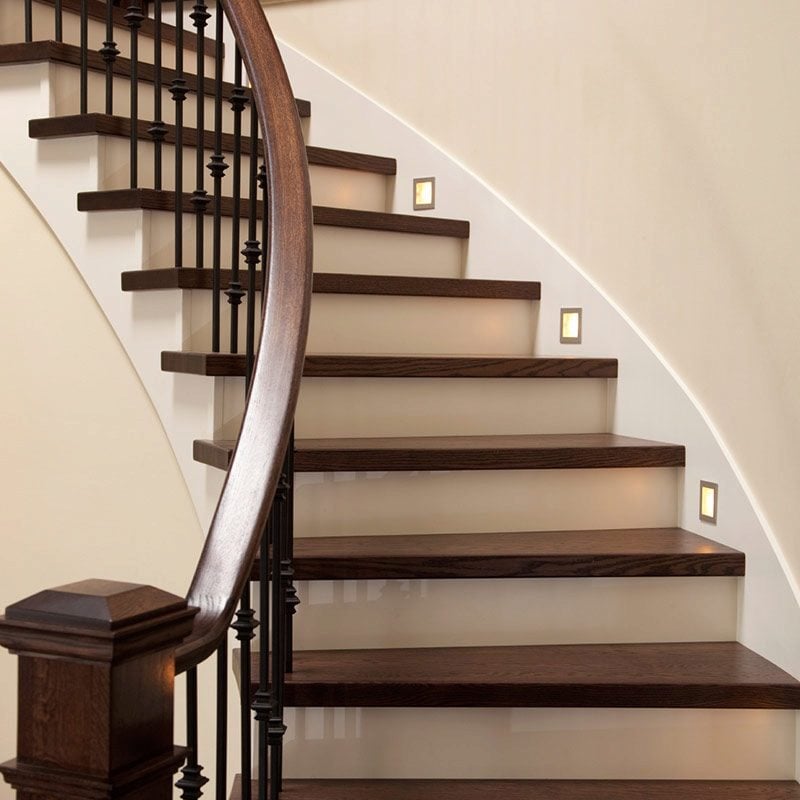
A stair tread is one of the most recognizable parts of a staircase. It's the horizontal board you step on as you climb or descend. Every staircase has them. Whether you're replacing worn boards, building new, or just learning stair vocabulary before a remodel, this guide covers what treads are, how they're sized, and what they're made of.
What Is a Stair Tread?
A stair tread is the horizontal surface of a step. It's the board your foot lands on. Treads span the full width of the staircase and rest on top of the stringers (the angled side supports). On an open side they also carry the balusters and the newel post that anchors the run. A typical wood stair tread is 1" to 1.5" thick, 10" to 11.5" deep, and anywhere from 36" to 48" wide depending on the stair width.
Tread vs. Riser vs. Nosing
One "step" is made up of three parts working together:
Part | What it is | Orientation |
|---|---|---|
Tread | The surface you step on | Horizontal |
Riser | The vertical board between treads | Vertical |
Nosing | The front edge of the tread that overhangs the riser | Horizontal overhang |
The stair riser closes the vertical gap between treads. The stair nosing is the part of the tread that projects out beyond the riser face. It gives your foot more landing surface and is required by code when tread depth is at the minimum.
Tread Depth vs. Tread Width
These two terms get mixed up. Here's the distinction:
Tread depth is the front-to-back measurement of the stepping surface. It's measured from the nosing (front edge) to the riser behind it. IRC code requires a minimum tread depth of 10". Most residential treads run 10" to 11.5" deep.
Tread width is the side-to-side measurement. This matches the width of the staircase opening. Standard residential stairs are 36" to 48" wide.
Don't confuse tread depth with stair rise and run. "Run" refers to the horizontal distance of one step as measured along the stringer, which accounts for the nosing overhang differently depending on how you measure.
Types of Stair Treads
Not every tread is the same. The right type depends on whether you're building new or remodeling over an existing stair.
Solid treads are full-thickness boards, typically 1" or 1.5" thick. They're used in new construction and full stair replacements. You get a complete, solid step with no layering.
Retro/overlay treads (also called cap treads) are thinner profiles designed to install over existing stair treads. They cap the old tread without requiring a full tear-out. They're a popular remodel option.
False treads are used in open-riser designs where the visual of a tread is maintained but the riser is open. They work with floating stair systems.
Bullnose starting steps have a rounded front edge and two rounded side returns. They sit at the bottom of the staircase and create a finished starting point. Learn more about starting steps and landing treads.
For a full breakdown, see the stair tread types guide.
Standard Stair Tread Sizes
Dimension | Common Options |
|---|---|
Depth | 10", 10.5", 11", 11.5" |
Width | 36", 42", 48" (custom available) |
Thickness | 3/4", 1" (nominal), 1-1/16", 1-1/2" |
Thickness matters for both feel and code compliance. Thicker treads feel more solid underfoot and are less likely to flex or squeak over time. Some designs call for thick stair treads at 1.5" or more.
What Are Stair Treads Made Of?
Wood is the most common material for residential stair treads. The most popular species:
Red oak: The industry standard. Durable, takes stain well, widely available. See red oak stair treads.
White oak: More neutral grain, increasingly popular for modern interiors. Compare white oak vs. red oak.
Maple, hickory, walnut, poplar: Each species has different hardness ratings, grain patterns, and stain compatibility.
The wood species buyer's guide is a good starting point if you're deciding between species.
Treads also come in prefinished and unfinished options. Prefinished treads ship ready to install. Unfinished treads are sanded and ready for your stain and topcoat of choice.
How Treads Attach to the Stringer
There are a few common methods:
Glue and nail: Construction adhesive is applied to the stringer, and the tread is face-nailed or brad-nailed. Simple, fast, and effective for most new construction.
Pocket screw: Screws are driven from underneath the tread into the riser or stringer. Leaves no visible fasteners on the tread surface.
Wedge and housed stringer: In a housed (closed) stringer, the treads slide into routed dadoes and are locked in place with wedges from underneath. Traditional and very solid.
For step-by-step details, the stair tread installation guide covers all three methods.
What Is a Stair Stringer?
A stringer is the angled structural board that runs along the side of a staircase, supporting the treads and risers. It's the backbone of the stair frame. Without it, the treads have nothing to rest on.
Open (cut) stringer vs. closed (housed) stringer
An open stringer is notched or "cut" so the tread and riser edges are visible from the side. You can see the profile of each step. A closed or housed stringer has routed dadoes inside; the treads and risers slide in and are invisible from the outside. The stringer face looks like a flat, angled board.
Stringer vs. carriage vs. jack stringer
"Carriage" is an older term for a cut stringer, and you'll still hear it used interchangeably. A "jack stringer" (or center stringer) is a middle support stringer added on wide staircases to prevent tread deflection. It carries load but isn't typically visible.
How many stringers does a staircase need?
Most residential staircases use two stringers, one on each side. Wider stairs (over 36") should have a center jack stringer added for support. Very wide staircases may need two interior supports.
Stringer vs. skirtboard
These two are often confused. The stringer is structural and carries the load of the treads. The skirtboard is a trim board that covers the wall side of the stair. It's not structural.
What Is a Skirtboard?
A skirtboard is the trim board that runs along the wall side of a staircase, between the finished wall surface and the stringer. It's decorative, not structural. Its job is to create a clean, finished line from the bottom of the stair to the top.
Skirtboard vs. stringer
The stringer carries the structural load of the treads. The skirtboard covers the wall-side face, hides the gap between the stringer and the wall, and creates a polished look. On a wall-mounted stair, you'll typically see a skirtboard but not the stringer.
Why skirtboards are used
Walls aren't always perfectly plumb, and rough framing leaves gaps. A skirtboard covers those imperfections and ties the stair visually to the wall. Without it, you'd see raw framing, drywall gaps, and the edge of the stringer.
Skirtboard materials and sizing
Skirtboards are usually made from the same wood species as the treads, or from paint-grade poplar if they'll be painted. Standard thickness is 3/4" to 1". Width varies based on the stair geometry, but 9" to 12" is typical.
Installing over an existing routed skirtboard
If your existing skirtboard already has dadoes routed for the original treads, you can install new treads to fit those existing routes. Alternatively, a new skirtboard is applied over the old one after treads are set.
How to Measure for Replacement Treads
Most ordering mistakes happen here, not at the checkout. Four measurements, in this order:
1. Depth (nosing to riser). Measure from the front edge of the existing tread back to the face of the riser behind it. Do not include the nosing overhang unless you are matching an existing nosed tread exactly — say which you measured when you order.
2. Width, and which ends are exposed. Measure wall to wall for a closed stair. For an open side, measure to the outside face of the stringer and specify that end needs a return — a mitred nosing that wraps the exposed end grain. One open side is a single return; an open starting step may need two.
3. Thickness. Measure the existing tread at the nosing. This determines whether a full 1" solid tread will fit or whether the rise will change enough to break the 3/8" consistency rule.
4. Check every step, not one. Older stairs settle. Measure the top, middle, and bottom tread — if they vary more than 1/4", order to the widest and scribe to fit rather than ordering one size for all.
If you are capping rather than replacing, measure the existing tread depth including its nosing, because a retro tread sits on top of it and adds thickness to every rise.
Shop stair treads
Treads are cut to your stair's exact width and species, so measure before ordering — the section above covers what to record.
Wood stair treads · Thick stair treads · Replacement treads · False treads & risers · Order a sample first
FAQ
What is a stair tread? A stair tread is the horizontal board that forms the walking surface of a step. It's what your foot lands on as you go up or down a staircase. Treads are supported by stringers on either side and sit directly on top of the riser below.
What are stair treads made of? Most residential stair treads are made from hardwood: red oak, white oak, maple, hickory, or walnut are common. They also come in softwoods like pine, or in engineered wood and laminate options. Hardwoods are preferred for durability.
Riser vs. tread: what's the difference? The tread is horizontal. The riser is vertical. The tread is what you step on; the riser is the board that closes the vertical gap between two treads. Together they form one complete step.
Does the top of the stairs count as a tread? No. The floor at the top of the staircase is not counted as a tread. The topmost "tread" is typically the upper floor surface itself. For a finished edge where the floor meets the top of the stair, you'd use a landing tread.
How deep should stair treads be? IRC requires a minimum tread depth of 10" measured from nosing to nosing. Most residential treads run 10" to 11.5". Deeper treads feel more comfortable and are required in some commercial applications. Use the stair rise and run calculator to dial in your measurements.
Internal links: Stair Anatomy Hub · What Is a Stair Riser? · What Is Stair Nosing? · What Is a Landing Tread? · Stair Rise and Run
Keep reading
All resources GuideStair partsRise and Run: What Are They and How Do You Calculate Them?Rise and run are the two core dimensions of every stair step. Learn the standard sizes, how to calculate them, and what the building code requires.8 min read
 GuideStair partsLanding Tread: What Is a Landing Tread?Learn what a landing tread is, how it differs from a stair tread, where landing treads are used, and when you need a landing panel instead.8 min read
 GuideStair partsBaluster: What Is a Baluster?A baluster is the vertical post that fills the open space of a stair railing. Learn how they differ from spindles and pickets, sizing, spacing, and more.9 min read