


Customized Box Newels

July 21st, 2008

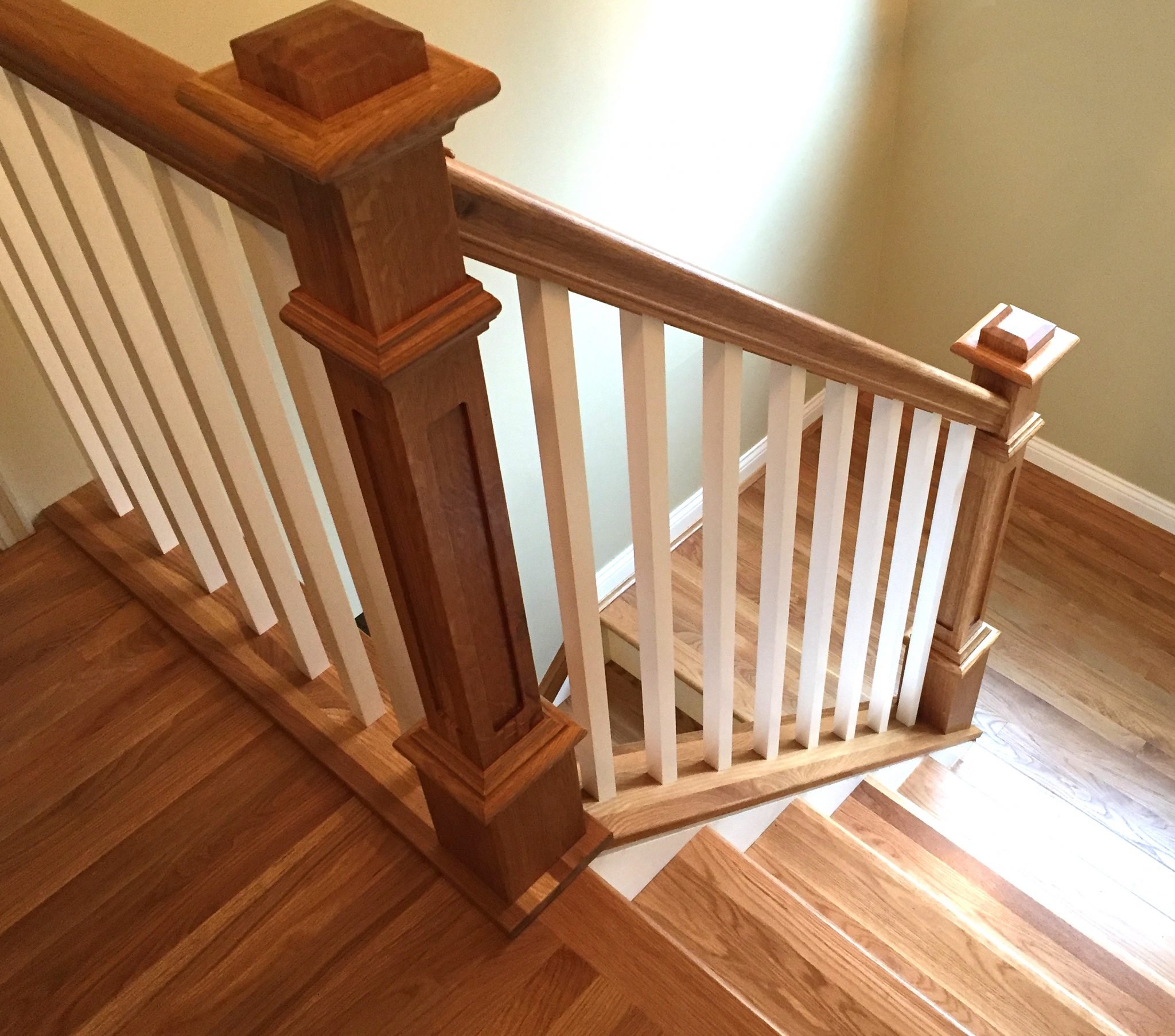
We constantly receive requests for customizations to box newels.  People want them longer, taller, fatter, cut at odd angles, with mixed wood species or different caps.  Our team of craftsmen love and challenge and routinely build box newels to fit our customers needs.  We have made posts and columns to match our box newels for special applications.  Several commercial projects have used 60 or more box newels.

Stair Supplies also manufcatures a line of exterior box newels constructed with exterior glue and different construction techniques for a long life in the outdoors.

Building box newels is the passion of our committed team.  You will love the box newels that we build for you.

Stair Parts in Walnut

April 27th, 2008

Walnut is back in vogue as a stair part.  Walnut has always been one of the most treasured woods for making furniture and fine quality millwork including stair parts.  Walnut has been a classic, but not popular for the past 20 years.  Now it is shifting back into the popular category.

Starbucks stores have jumped on the walnut bandwagon and every store that have been in around the world has been filled with furniture made in walnut.  The dark wood of walnut is a natural complement to the dark coffee in the coffee houses.

Walnut is a great stair part because it requires no stain to have a beautiful finish.  Walnut is one of the easiest woods to cut, shape and sand.  Installers love to work with quality woods like walnut.

The downside to walnut for stair parts is that it is not always available in long lengths and walnut often has lots of knots.  Stair supplies selects the best lumber possible and cuts around the knots, but it can be difficult when customers specify several pieces of handrail over 14 feet long.  Walnut is not as hard as other woods that are made into stair parts, but it will work well as a stair tread.  Walnut is 1010 on the janka scale and red oak is 1290.

Stair specialist can help you to determine the best wood for your application and the right stair parts for you project.  Call or contact us 1 866 226 6536.

Stair codes: Consistent Rise

April 22nd, 2008

Why do we have all of these annoying stairway codes when building and remodeling a house?  Why do we need codes for stairs?  Well after walking through Asia I have learned why.
Nearly every stairway that I  have ascended during my stay in Asia has some factor that would keep it from passing a code inspection in the USA or Canada.

The most annoying code violation that I experience is an inconsistent rise.  In the US code requires that there cannot be more than a 3/8″ difference in rise between any two steps on a stairway.  This helps a person walk up a stairway and be able to pick up their foot a consistent amount.  It is something that most people in the USA and Canada take for granted for their stairway.  Walking up stairs here I have stumbled or stubbed my toe numerous times because of the change in rise which can be as much as 2 inches on the first or the last step in the stairways.

Another common violation from North American standards is handrails on stairs.  A few years ago my very active and healthy mother-in-law was walking down a beautiful curved marble stairway in South America which didn’t have a handrail.  She stumbled (due to inconsistent rise in the steps) and fell breaking both bones in her leg.  She ended up with a surgery in a South American hospital, several pins, screws and plates in her leg.  She had an extra 2 weeks stay in a South America.  If the stairway had a handrail and a consistent rise to the steps this injury would have been avoided.

New Wrought Iron Baluster!!

April 9th, 2008

We have a new Wrought Iron Baluster on our website. We also have a new series, called the Venetian Series. This new baluster, 16.4.1 is the first item we have in that series. This 3/4″ X 44″ Baluster is almost Victorian looking but with a modern look to it. A beautiful addition to your stairs that looks good with any primed box newel.

Tigerwood stopped them in their tracks

March 27th, 2008

A prefinished Tigerwood order went through our process this week and it stopped everyone in their tracks.  The office staff and the craftsmen were amazed at how beautiful the tigerwood is when it is finished with a clear finish.  The order had newels, treads and a platform and all of them had incredible character.  The tigerwood had ray flecks, stripes, mixes of browns that are amazing to see.   If you have a stairway that needs a unique look, tigerwood treads, newels and handrails is your best choice.

Prefinishing Stair Parts

March 21st, 2008

Stairsupplies has been prefinishing stair parts consistently for the past several months with the assistance of our neighbors spray booth.  Now we have our own spray booth completed and we will be able to start spraying treads, handrail and other stair parts ourselves.  We have done a lot of research and testing with the use of our neighbor’s booth on the best finish for stair parts.  We have found a finish that is environmentally friendly and very durable.  The look is great also.  So what is the trade-off.  Obviously the finish is more expensive than other finishes.  We have decided it is worth it.

Box newel cell improvements

March 20th, 2008

For the past month we have worked to improve our box newel cell.  The improvements involve a move to a new building with more space and dedicated machines.  When the box newel cell is completed the cell will be able to go from raw lumber to a completed box newel in about 3 hours.  In my next post about box newels I hope to show pictures and give more updates on the progress.

Tight radius work

March 12th, 2008

Really tight radius curved stairs are difficult for bending handrail.  Recently we had a very short, but extremely aggressive bend in a stairway where we helped the customer install the handrail.  To achieve the tight bend we did a process of moistening and pre-bending the handrail.  Because of the extreme amount of moisture that we applied to the handrail we used Titebond 3 glue to be certain we had a waterproof glue hold.  We pre-bent the handrail by successively bending the handrail farther into the radius over a period of 2 days.  We pre-bent the handrail even farther than the final radius which reduced the spring back when we finally glued the handrail

New 4447 Newel!

January 16th, 2008

We have recently added a newel to our beautiful Victorian Series! The 4447 Newel is very similar to its brother, the 4442 newel. The differece is the long block we added to its top, and in return made the bottom block shorter. This gives more visual weight to the top of the newel, rather than the bottom, like the 4442. This design makes the newel more appealing to the eye, because its closer to the eye level. It will get more attention and be the perfect fit for your stairway.

Rail bolt kits for attaching handrail

January 14th, 2008

Customers often wonder why they need a rail bolt kit to attach handrail to fittings or handrail to newel posts. “Can’t we nail them together?” is one of the questions that we hear. Nailing fittings together is possible and I’ve seen in done in a few homes, but nailing handrail to a handrail fitting or to a newel post is weak and very unsightly. The rail bolt kit forms a strong mechanical bond that isn’t affected by changes in moisture content of the wood.

A rail bolt kit is a 1/4″ threaded bolt which contains machine screws on one end and wood threads on the other. Drill a hole into the center of the handrail fitting or stair newel post. Insert the wood threads into the hole in the handrail fitting. A rail bolt wrench is a necessary tool for inserting the rail bolt into the handrail fitting without damaging the threads.

Drill a 1/2″ hole into the center of the handrail. Drill a 3/4″ hole in the bottom of the handrail so that it intersects the1/2″ hole. Fit the handrail over the stud and put the washer over the stud. Use the railbolt wrench and the rubber band to start the nut on the railbolt wrench. Apply glue to the faces of the handrail and the handrail fitting. Tighten the nut on the rail bolt. Be sure that the handrail and the fitting are perfectly aligned. Insert the plug into the bottom of the handrail using glue. When the glue has dried, sand the plug so that it is flush.

The joint between the handrail and the handrail fitting is now strong and durable for many years.